The Day I Realized Most Enterprise AI Is Just Expensive Autocomplete
A few months ago, I was talking to a founder who proudly showed me his company’s “AI-native workflow stack.”
There were copilots everywhere.
One tool summarized meetings.
Another generated emails.
Another predicted churn.
Another created dashboards from natural language prompts.
Another “agent” assigned tasks automatically.
The demo was honestly impressive.
Then I asked a simple question:
“Why did your biggest customer churn last quarter?”
As much as I wanted that agent to answer that, I was pretty much convinced, it won’t be able to and it did prove me right (something you rarely experience these days)
The CRM had notes.
The support platform had tickets.
Slack had conversations.
The product analytics tool had usage data.
The AI assistant generated a neat summary.
But nobody, not even the AI, could connect the story.
And that’s when something clicked for me.
We keep talking about AI as if intelligence is the missing piece.
I don’t think it is anymore.
I think the real problem is memory.
AI Has Become Very Smart.
Enterprises Have Not.
This is the weird contradiction of modern software.
We now have models capable of:
writing decent code,
passing legal exams,
generating realistic videos,
building presentations,
debugging applications,
sounding dangerously convincing in meetings.
Meanwhile, inside many enterprises?
People are still manually stitching together context from:
emails,
dashboards,
CRMs,
Slack threads,
spreadsheets named
final_v7_REAL.xlsx,and that one employee who somehow knows everything but is always on leave when production breaks.
Ah, the legendary "Phantom Expert." They know the IP address of the mainframe, the exact sequence of the secret handshake to fix the copier, and which specific screw to tighten on the production line, except when there is a fire in the box.
The Real Enterprise Problem Nobody Talks About
Most companies don’t suffer from lack of data.
They suffer from fragmented memory.
That’s very different.
A dashboard can tell you:
“Customer engagement dropped 18%.”
Cool.
But that’s like a smartwatch telling you:
“Your heart rate is unusual.”
Useful? Sure.
Helpful enough to understand why? Naah.
Because maybe:
pricing changed,
onboarding got delayed,
the customer’s internal champion left,
support response times slipped,
or your competitor launched a cheaper plan two weeks earlier.
Humans naturally connect these dots.
Most AI systems today don’t.
They retrieve information.
They don’t truly understand evolving context.
And Honestly… That’s Not the Model’s Fault
We keep expecting LLMs to behave like experienced operators.
But we’re giving them the memory architecture of a goldfish.
Every query starts almost from scratch.
The model sees:
a prompt,
some retrieved documents,
maybe a few previous interactions,
and then generates a response.
That works beautifully for:
writing,
summarization,
coding assistance,
documentation,
and static knowledge retrieval.
But operational environments are different.
Because operations are not just about information.
They’re about history.
Patterns.
Behavior.
Sequence.
Cause and effect.
The Difference Between Data and Experience
Imagine two doctors.
The first doctor has access to every medical textbook ever written.
The second doctor has fewer books…
but 20 years of pattern recognition from treating thousands of patients.
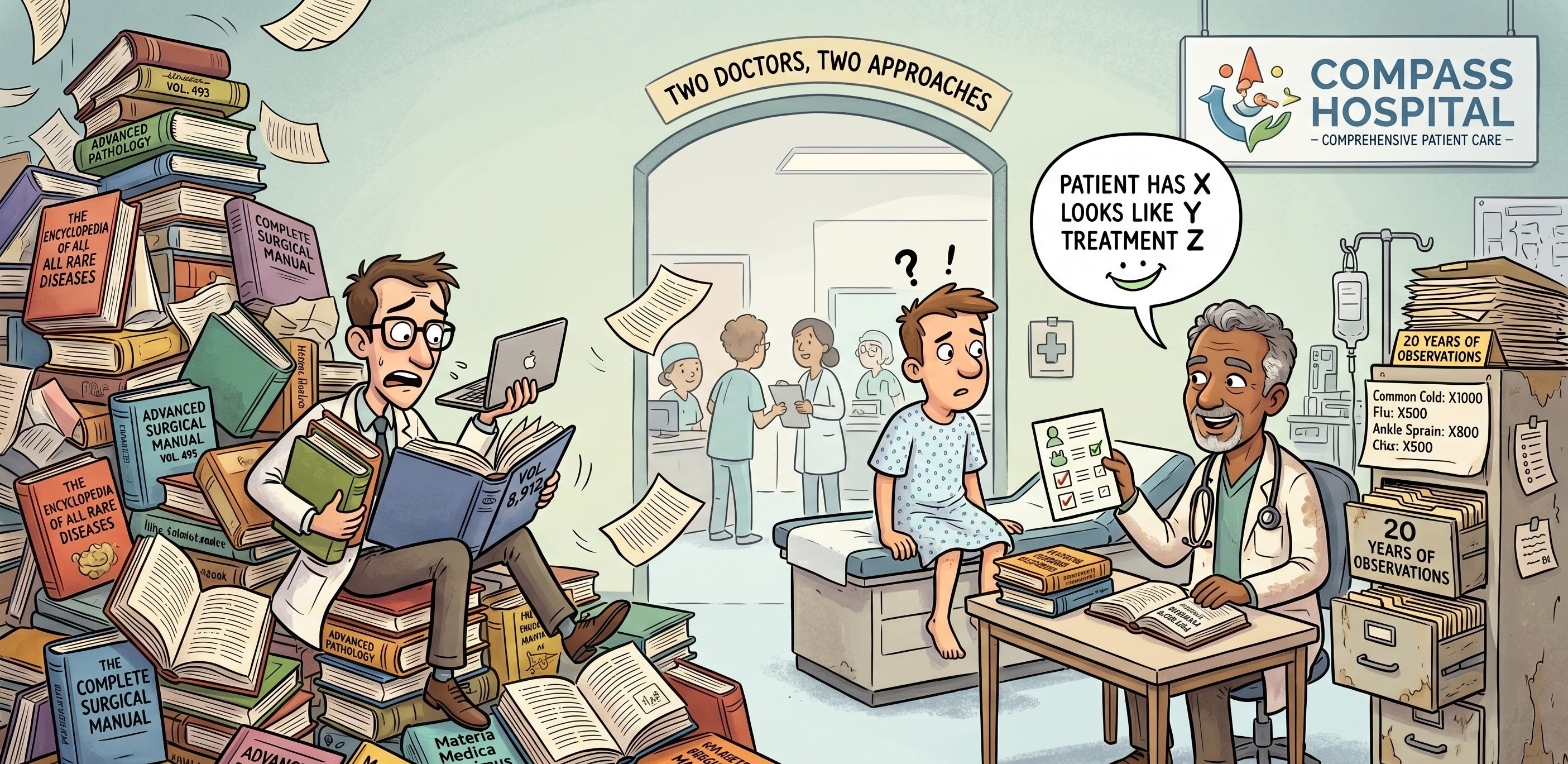
Who would you trust more during a difficult diagnosis?
Exactly.
That’s the gap enterprise AI is facing right now.
Most AI systems today are extremely knowledgeable.
But they are not experienced.
Enterprises Are Quietly Suffering From Corporate Amnesia
And not Digital Dementia (To read more on that, checkout this)
This part fascinates me.
Every organization leaks intelligence constantly.
A senior engineer resigns.
Suddenly nobody remembers why a critical workaround exists.
A sales leader leaves.
Half the customer nuances disappear with them.
A product manager exits.
Three months later the company starts debating ideas that already failed two years ago.
I’ve seen companies repeat the same strategic mistakes simply because the people who remembered the original failure were no longer around.
And ironically…
The bigger the company gets, the worse this becomes.
At scale, organizations slowly become forgetful.
Why Most AI Copilots Feel Impressive for 10 Minutes
Let me say something slightly controversial.
A lot of enterprise AI today feels like:
“autocomplete wrapped in venture funding.”
The interfaces are beautiful.
The demos are polished.
The prompts sound magical.
But underneath?
Most systems still lack persistent operational understanding.
Ask many AI assistants:
“What’s happening with this customer?”
And you’ll get:
summaries,
notes,
extracted action items,
maybe sentiment analysis.
Useful.
But shallow.
A truly intelligent operational system would instead say something like:
“This account resembles three previous customers that churned after procurement delays. Product adoption has slowed for six weeks, executive engagement disappeared after pricing discussions, and support escalations are rising. Historical probability of renewal is falling.”
That’s not summarization anymore.
That’s judgment.
Huge difference.
The TL;DR Judgment
A manager asks an AI to summarize a 50-page, disastrous project report.
AI Output: “TL;DR: The project is a complete failure, everyone should be fired, and the coffee machine is broken.”
Manager: “I needed a summary, not a premature judgment!”
AI: “That’s what I call a 100% accurate, low-latency summarization of your incompetence.”
Bigger Context Windows Won’t Magically Solve This
This is another industry illusion.
Every few months, somebody announces:
longer context windows,
faster inference,
smarter agents,
autonomous workflows.
And people immediately assume:
“Ah. We solved memory.”
Not really.
Because enterprise reality is messy.
A mid-sized company generates:
meetings,
tickets,
product events,
emails,
customer interactions,
Slack messages,
incident reports,
deployment logs,
and operational signals…
every single minute.
No model is realistically going to brute-force all of that context continuously in real time.
The future is not:
“stuff more tokens into prompts.”
The future is:
“build systems that learn organizational behavior over time.”
This Is Where Things Start Getting Interesting

I think the next wave of enterprise AI will look less like chatbots…
…and more like organizational memory systems.
Systems capable of remembering:
what worked,
what failed,
which patterns matter,
how behaviors evolve,
and which signals historically precede important outcomes.
Not static memory.
Adaptive memory.
The kind humans develop through experience.
The Shift Nobody Is Pricing In Yet
Right now, most enterprises are still buying AI tools.
But underneath that…
they are unknowingly building cognitive infrastructure.
That sounds futuristic, but think about it.
What happens when a system continuously learns:
how your organization sells,
how incidents emerge,
how hiring succeeds,
how fraud patterns evolve,
how customer behavior changes,
and how internal decisions affect outcomes?
At some point, the software stops behaving like software.
It starts behaving like accumulated institutional intuition.
And that changes the economics of entire industries.
The Companies That Win May Not Have the Best Models
This is the part I find most important.
Foundational models will eventually commoditize.
That always happens with infrastructure.
But organizational memory?
That compounds.
Two companies can use the exact same LLM.
What they cannot copy from each other is:
years of operational history,
decision patterns,
feedback loops,
customer behavior,
internal workflows,
and accumulated learning.
That becomes the moat.
Not the model.
The memory.
A New Enterprise Stack Is Quietly Emerging
Most people still imagine AI systems like this:

But I think future enterprise systems will evolve into something closer to this:
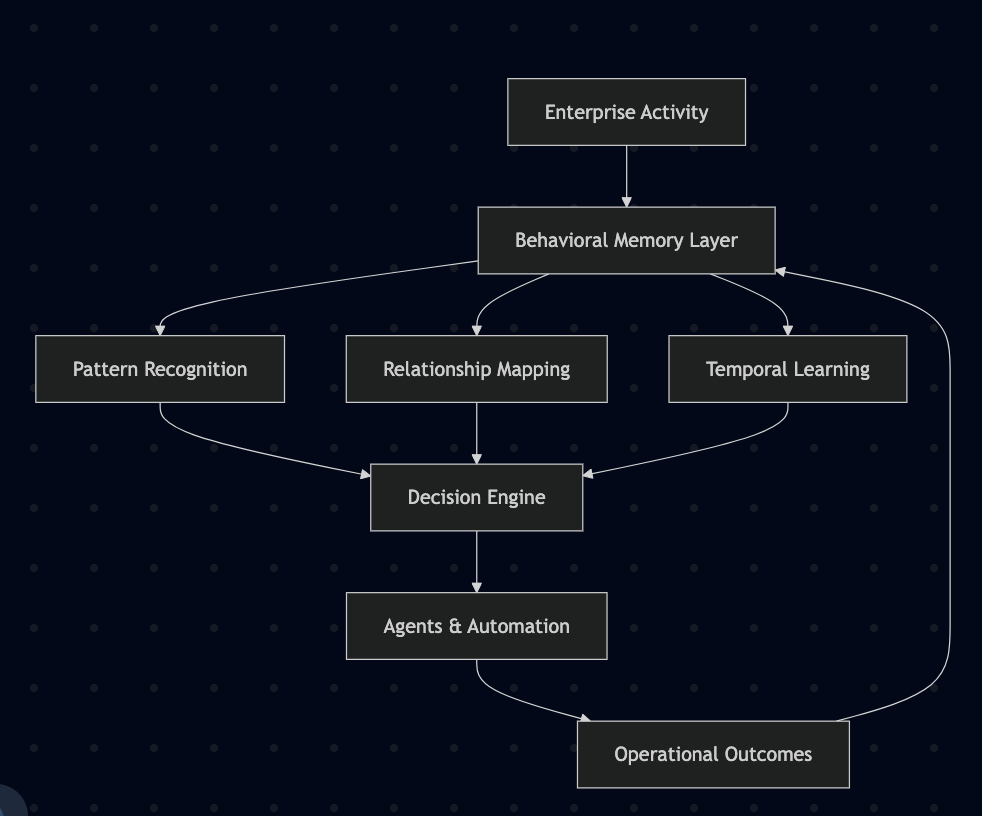
The key difference?
The system improves from experience.
Not just prompts.
The Quiet Death of Dashboards
I don’t think dashboards disappear entirely.
But I do think their role changes dramatically.
Dashboards were designed for humans manually interpreting systems.
But modern businesses move too fast for static interpretation.
By the time someone notices:
“Customer engagement dropped,”
the customer may already be testing a competitor.
Future enterprise systems will likely spend less time visualizing reality…
…and more time reasoning about it continuously in the background.
Almost like a second nervous system for the organization.
The Strange Future We’re Walking Into
I think we are slowly entering a world where companies will operate with two parallel brains.
Human Brain
Handles:
vision,
ethics,
creativity,
judgment under ambiguity,
long-term direction.
Machine Brain
Handles:
pattern detection,
operational memory,
anomaly recognition,
prediction,
and continuous optimization.
The companies that combine both effectively will move frighteningly fast.
And the companies still relying purely on disconnected dashboards and siloed tools may eventually feel like businesses trying to navigate modern warfare using printed maps.
Final Thought
For years, the AI conversation was dominated by one question:
“How intelligent can the models become?”
I think the more important question now is:
“What happens when AI systems start remembering organizations better than organizations remember themselves?”
Because that is no longer just automation.
That is the beginning of institutional cognition.
- Hardik