The AI Job Apocalypse Is a Myth. Here's What's Actually Happening.
I’ve been building software for around two decades now.
I’ve survived the dot-com crash. The outsourcing wave. The cloud migration panic. The low-code “no more developers” moment. And no fewer than four distinct “automation will eat your job” cycles, each with its own villain of the decade.
None of them finished anyone off.
And now we’re here again. Same script. New cast member.
This time, the villain is AI.
Every other week there’s a viral post claiming software engineers are done, white-collar work is quietly collapsing, and mass unemployment is just one model release away. The discourse moves fast. The fear moves faster. And somewhere underneath all of it, a very specific narrative keeps repeating itself, slightly louder each time.
It’s emotionally compelling. It’s well-produced. And it’s missing about half the story.
Who Actually Profits From the Fear
Here’s the thing about apocalyptic AI narratives: they don’t spread because they’re accurate. They spread because they’re useful.
Frontier AI labs need the world to believe their technology is civilization-altering. That’s not pessimism about their motives, it’s just how trillion-dollar valuations get defended.
Investors benefit from the perception of infinite disruption. “This changes everything” is a much better LP deck than “this automates some Excel work.”
SaaS vendors need enterprises to believe that replacing human workflows with AI is the next mandatory cost revolution, otherwise why is anyone signing that contract?
And corporations quietly doing post-overhiring corrections? They benefit enormously from “AI transformation” as a headline. It’s a cleaner story than: “We hired aggressively during zero-interest years and are now fixing our balance sheet.”
Fear has always been an excellent distribution strategy. AI fear just distributes exceptionally well because it touches everyone: engineers, writers, designers, analysts, lawyers, and anyone who has ever wondered if their job could theoretically be described in a paragraph.
The weird part? All of this can be true, and AI can still be a genuinely profound technology. Those aren’t contradictions. They’re just competing incentives operating in the same news cycle.
What the Data Actually Says (Annoyingly)
If you zoom out past the viral posts and look at what’s actually happening in labor markets, the story gets considerably less dramatic.
U.S. unemployment has remained historically moderate through this entire supposed displacement wave. Software engineering hiring cooled from its pandemic-era frenzy, but it cooled the way a market corrects after overheating, not the way an industry collapses. Meanwhile, AI-adjacent roles: infrastructure, evaluation, orchestration, safety, platform, and reliability engineering, are actively exploding.
The strongest signal in the data isn’t job destruction. It’s job transformation. And that distinction, tedious as it sounds, matters enormously.
We’ve Seen This Movie
History is embarrassingly consistent on this point.
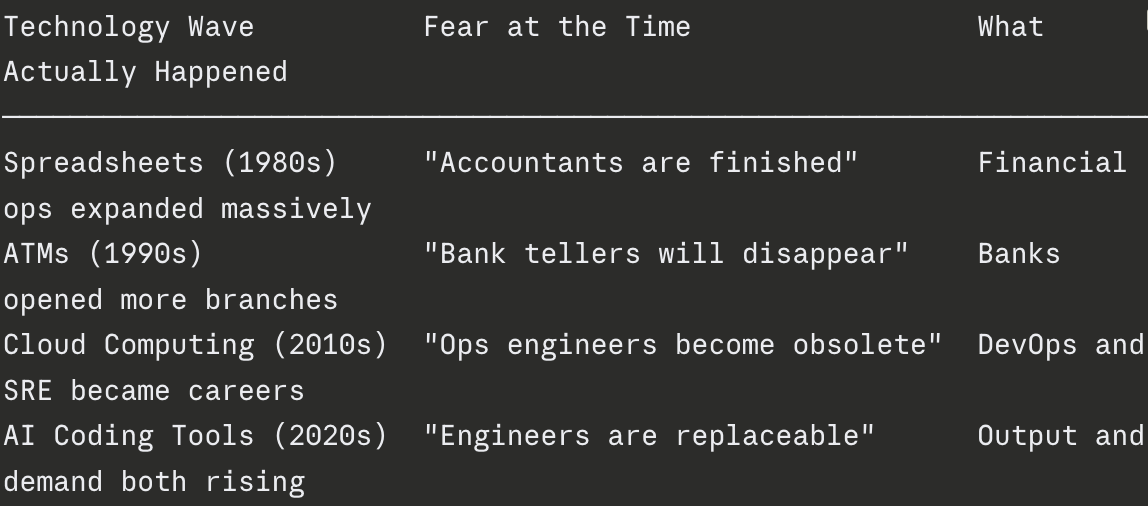
Automation almost never destroys the full system. It changes the shape of work. And when productivity increases, markets typically expand, which creates second-order demand for more products, more infrastructure, more tooling, more maintenance, more specialization, and eventually, more jobs in categories that didn’t exist before.
This isn’t optimism. It’s just how every previous wave actually played out.
The Fear Playbook Has Been Run Before
And it’s not just technology. Society has a reliable habit of overreacting to narratives when institutions amplify fear faster than nuance.
Nuclear energy got so thoroughly fear-cycled in public discourse that governments systematically underinvested in it for decades. The downstream result was greater fossil fuel dependency and worse long-term climate outcomes. We scared ourselves into a worse world.
Population growth predictions in the 1970s triggered aggressive policy responses globally, based on projections that never materialized. Dietary fat panic rewired an entire food industry toward low-fat, high-sugar formulations, under the banner of public health, with consequences we’re still managing.
The pattern is consistent: simplified fear narratives spread faster than complex reality. Nuance doesn’t go viral. Existential dread does.
AI discourse is increasingly following the same playbook.
What’s Actually Changing (The Honest Version)
Here’s where I won’t swing to the opposite extreme, because that would be equally dishonest.
AI is changing work. Meaningfully.
Some teams that previously needed five engineers for certain execution-heavy workloads may now need three. Repetitive production work is getting automated at real scale. Junior-level execution tasks are being compressed in ways that are visible to anyone actually paying attention.
That part is real. Pretending otherwise isn’t reassuring, it’s just denial wearing a different outfit.
But: work changing is not the same thing as jobs disappearing.
The workflow is evolving. The bottleneck is shifting.
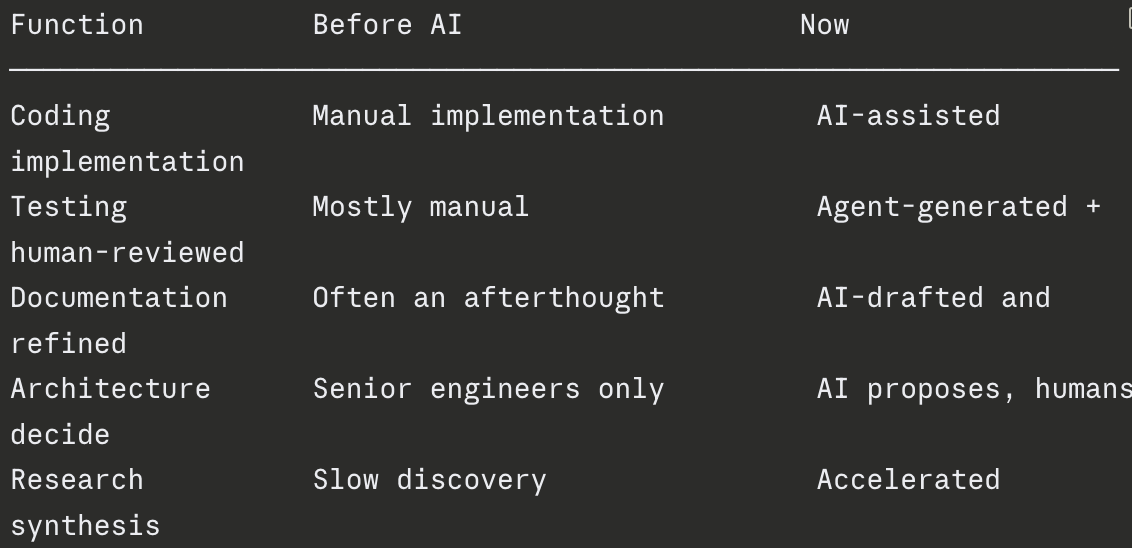
The constraint is no longer raw execution. The new bottleneck is judgment, taste, prioritization, systems thinking, accountability, and the ability to make decisions when the situation is ambiguous and the stakes are real.
AI reduces friction. It doesn’t replace accountability. And in every organization I’ve seen, accountability was already the scarce resource.
The Real Diagram
Here’s the two futures that are actually on the table:

The second model is historically far more common. Not universally. Not without disruption. But as the base case.
The Real Prediction: An Actual Jobpalooza
Here’s what I think is actually coming, based on the patterns I’m watching.
More AI engineering roles, not fewer. The infrastructure required to productionize AI at enterprise scale is enormous and largely unbuilt. Organizations need AI platform engineers, evaluation specialists, MLOps architects, agent orchestration engineers, AI reliability engineers, governance tooling, and human-in-the-loop workflow systems. Most companies are barely past the prototype phase. The build-out is just beginning.
Hybrid roles become the baseline. The highest-leverage professionals will be the ones who combine domain expertise with AI fluency. Designers who can direct generative systems. Analysts who can orchestrate AI workflows. Product managers who deeply understand automation. Engineers who supervise autonomous agents. These won’t be premium specializations. They’ll be table stakes within a few years.
Software creation explodes. As the cost of building software falls, more businesses will build internal tools, niche products, and operational automations that previously weren’t worth the budget. Which means more startups, more ecosystems, more integrations, and more operational complexity. That complexity doesn’t disappear. It creates work.
Honestly, the most underrated outcome of cheap code generation isn’t fewer engineers. It’s dramatically more software in the world, most of it needing maintenance, iteration, and the kind of judgment that models still reliably fumble.
The Constraint Was Never Typing Speed
This is the part that gets lost in the discourse.
In software, the real bottleneck was never execution velocity. It was always good ideas, good judgment, market understanding, consistent prioritization, and the ability to coordinate across teams where nobody fully agrees on the requirements.
AI dramatically lowers the cost of execution. Which means more people can build things. And when the cost of building decreases, the number of things worth building almost always increases. This is exactly what happened with cloud infrastructure, open-source ecosystems, mobile frameworks, no-code tools, and APIs.
Each of those unlocked new categories of work rather than eliminating existing ones.
AI is another acceleration layer. A significant one. But it follows the same physics.
What Practitioners Should Actually Do
If you work in technology, data, product, or any knowledge-intensive field, here’s the version of advice that doesn’t require a motivational poster:
Stop consuming doom content as signal. Fear content spreads because it monetizes attention, not because it predicts reality accurately. Viral posts about mass displacement are written to be shared, not to be correct. That’s a different optimization function.
Build with AI now, not later. The compounding advantage of early fluency is real. The engineers experimenting with AI-native workflows today will outperform the ones still debating whether AI is “real” next year. This isn’t hype. It’s just compound interest on skill.
Develop judgment, not just execution skills. Execution is increasingly commoditized. The premium shifts toward knowing what to build, understanding trade-offs, designing systems, and communicating clearly under ambiguity. That’s not soft skill advice. That’s where the leverage is moving.
Teach the people around you. The best hedge against displacement is collective capability. Teams that build AI fluency together compound faster than individuals trying to stay ahead alone.
Final Thought
My experience of building systems taught me one thing with real confidence:
Technology changes. Humans adapt. Work evolves. And the labor market reorganizes itself around new leverage, usually in ways nobody predicted precisely and everybody claims to have seen coming.
AI will absolutely reshape industries. Some roles will shrink. Others will emerge. Some of those emerging roles don’t have names yet, which is uncomfortable, but also exactly what happened with cloud engineers, data scientists, and DevOps practitioners about a decade ago. Nobody had those job titles. Then everyone did.
The idea that society will suddenly stop needing ambitious, creative, technically capable humans? That’s the least believable part of the entire narrative.
Somehow, despite every wave of automation in history, the demand for people who can think clearly, build well, and make good decisions under uncertainty has only ever gone up.
That’s probably not a coincidence.
What are you actually seeing in your organization right now? More AI-driven hiring? Quiet displacement? Or just a shift in how work gets done? Genuinely curious what practitioners across industries are observing.
-Hardik