The AI Hype Machine Has a Supply Chain. And Supply Chains Break.
There’s a specific kind of silence that happens in a boardroom when someone asks, “But when do we actually see ROI?”
That silence has been growing louder across every enterprise that enthusiastically allocated budget to AI pilots last year. Not because the technology is bad. It isn’t. It’s genuinely remarkable. But somewhere between “ChatGPT passed the bar exam” and “let’s restructure our entire ops team around LLMs,” the industry collectively confused capability with deployability.
And those are very different things.
Went through this paper by Raghuram Rajan and the article captures some interesting insights.
The Supply Chain Nobody Drew on the Whiteboard
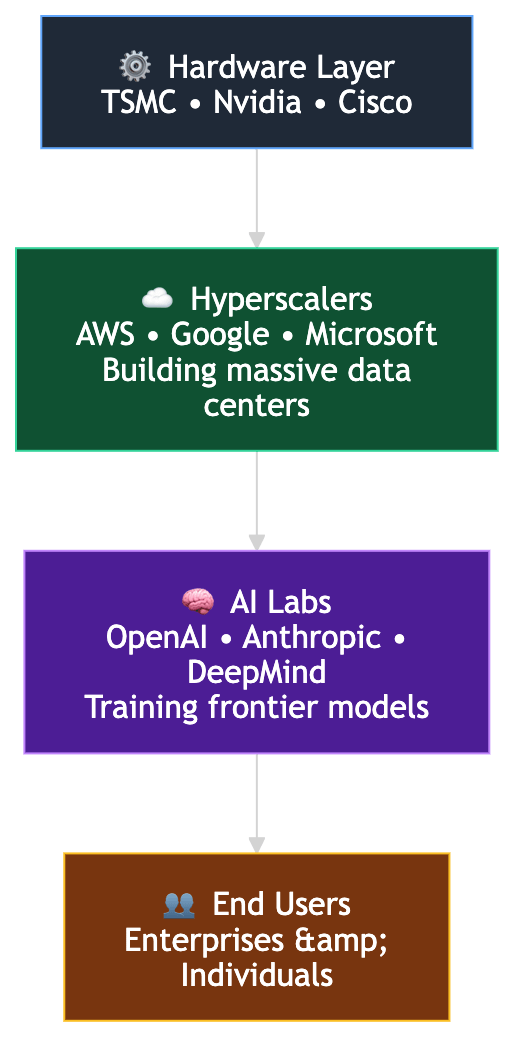
Here’s the thing about AI that most breathless LinkedIn posts conveniently skip: it isn’t a product. It’s a supply chain. A long, fragile, debt-laden supply chain with multiple places it can quietly break.
At the top, you have the hardware layer. TSMC fabricating chips. Nvidia designing them. Cisco keeping everything connected. These companies are printing money right now, and they deserve to. Demand is real, compute is scarce, and everyone needs more of both.
Then come the hyperscalers: AWS, Google, Microsoft. They’re building data centers so aggressively that entire Indiana counties have declared moratoriums on new construction. Not a metaphor. Actual legal moratoriums.
Below that, the AI labs themselves. Anthropic. OpenAI. Google DeepMind. Training massive models on the wager that whichever model becomes self-improving first will own the category.
And at the bottom: enterprises and individuals, the actual end users, whose adoption is the entire thesis for every dollar spent above them.
Sounds clean, right? Linear. Logical. Inevitable.
Turns out, every single layer is carrying assumptions that may not survive contact with reality.
The Self-Improvement Race Is Probably a Fairy Tale
Let’s talk about the throne nobody has sat on yet.
The current theory driving billions in AI training spend goes roughly like this: the first model to reach recursive self-improvement will become so dominant that all other competitors become irrelevant. First mover takes all. Everyone else goes home.
The weird part? Even if such a threshold exists, it’s not clear why it produces a monopoly. Competitors can observe the output of a capable model. They can hire away the people who built it. Trade secrets in software have historically held up... about as long as the engineers stay. Which is to say, not very long.
So far, no AI model has demonstrated sustained advantage over another. Claude, ChatGPT, Gemini: they trade wins across benchmarks like it’s a rotating trophy. Unless these systems find genuinely distinct user segments, or pull a very 20th-century move and merge/collude, the profit math required to justify their training budgets is... aspirational. To put it charitably.
The Enterprise Paradox
Here’s where it gets particularly interesting.
Enterprise AI adoption isn’t slow because companies are stupid or scared. It’s slow because companies have something that early adopters don’t: institutional memory of what happens when you bet your operations on infrastructure that’s still figuring itself out.
Most large companies are still organizing historical data so they can even train AI for their own use cases. They’re rethinking workflows that weren’t designed with automation in mind. They’re genuinely worried about hallucinations that could damage brand trust, data security breaches that could end careers, and AI errors that could land them in regulatory trouble.
Meanwhile, the scrappier, younger competitors are adopting faster and putting pressure on them. Classic innovator’s dilemma. Just with better PR.
The irony is this: the enterprises most capable of benefiting from AI at scale are also the most structurally unable to move quickly. Most enterprises operate like sleep-deprived interns with 47 browser tabs open. Adding an AI copilot doesn’t close the tabs. It opens more.
Regulation: The Variable Everyone Modeled Out
There’s a quiet assumption baked into most AI growth projections. It goes: “governments will probably do something, but slowly and incompetently, so we have runway.”
That assumption is getting shakier.
Data centers consume extraordinary amounts of power. Not “significant” power. Extraordinary, grid-straining, electricity-price-hiking power. That’s not an abstract environmental argument. That’s a very concrete political argument for state governments who have constituents complaining about rising power bills and tech campuses they can’t tax adequately.
And beyond energy: deepfakes are proliferating. Hackers are getting better. Children are being exposed to unsupervised AI systems. One genuinely bad incident, adequately covered, could trigger the kind of regulatory response that reshapes the entire deployment roadmap.
The chorus demanding liability frameworks for AI models is going to get louder. The question isn’t whether policy intervention happens. It’s whether the industry gets ahead of it or gets surprised by it.
What Actually Breaks First?
If you’re thinking about this structurally, the risk isn’t evenly distributed.
Hardware makers look fine for now. Demand is real. But if data center construction gets interrupted by regulation or energy constraints, the equipment filling existing centers depreciates rapidly. That’s ugly math for anyone amortizing over a long horizon.
AI labs face perhaps the strangest problem: they’ve raised at valuations that require sustained, exceptional monetization, on models that may be commoditizing. Unless differentiation becomes real and durable, they’re running a very expensive race to... parity.
And enterprises? They have the most optionality. They can wait. They’re taking the time to find uses that augment workers rather than displace them. Which is actually the healthier outcome, both socially and politically. Slower adoption may be what gives regulators and workers enough time to adapt without things breaking badly.
The irony of ironies: the careful, boring, cautious enterprise adopters might be the ones who end up building the most durable AI advantage. While the aggressive, debt-funded players discover that moving fast doesn’t matter much when the infrastructure they moved fast toward turns out to be a constrained resource.
The Part That Should Make You Pause
Here’s the honest read: AI is not a bubble in the classic sense. The technology is real, the applications are multiplying, and the long-term productivity gains are very likely genuine.
But “the technology will eventually be transformative” and “the current investment structure will produce the expected returns” are two entirely separate sentences. And right now, the market is treating them as synonyms.
LLMs have become extraordinarily capable on what is essentially sophisticated next-word prediction. That’s not a criticism. It’s almost philosophically strange how far that simple mechanism has taken us. But it could plateau before the next leap emerges. And the gap between “plateau” and “another technique” is exactly where debt becomes unforgiving.
The companies that survive this will likely be the ones who figured out the right thing to do while everyone else was figuring out the most expensive thing to do.
The strangest part isn’t that the hype might be wrong. It’s that even if the hype is mostly right, the timing and distribution of who profits could look almost nothing like the current narrative.
And in technology, the difference between “right idea, wrong timing” and “right idea, right timing” is usually measured in body count.
What’s your read? Is the AI supply chain as fragile as it looks from the outside, or is this just the predictable growing pain of a genuinely transformative platform? Drop a comment.
- Hardik
The original paper by Raghuram Rajan is here.